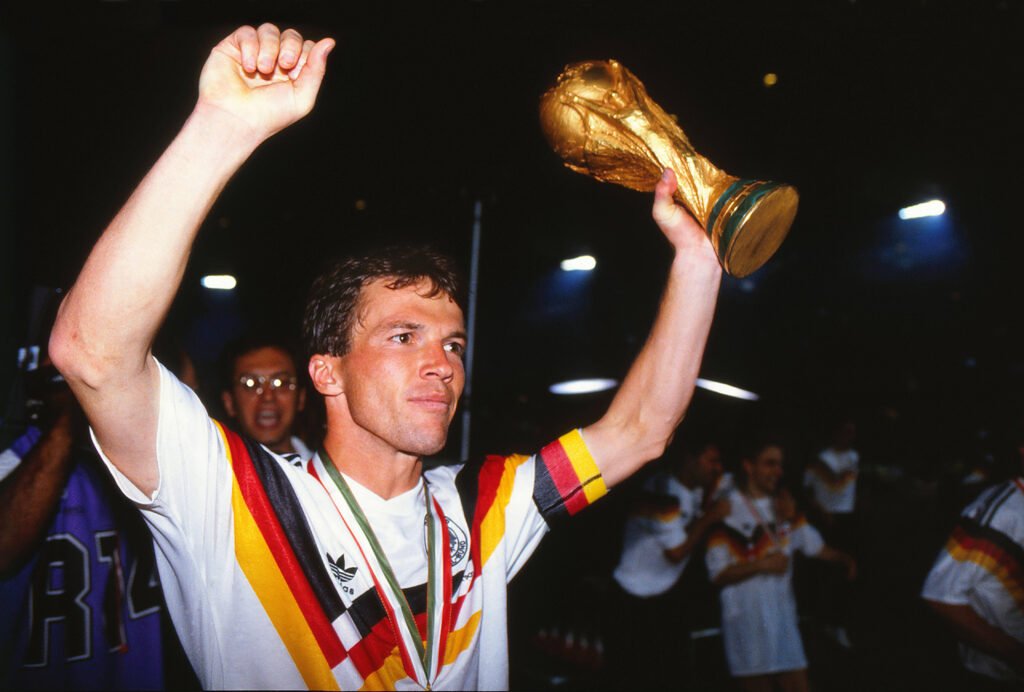
Many assume Lothar Matthäus was simply a great midfielder. The reality is more complex. He redefined the sweeper role, captained West Germany to World Cup glory in 1990, and still holds the record for most World Cup matches played. Yet his managerial career fell short of expectations, and his outspoken nature often sparked debate.
What Is Confirmed and What Remains Disputed About Matthäus
Lothar Matthäus was born on March 21, 1961, in Erlangen, West Germany. He began his professional career at Borussia Mönchengladbach in 1979. These facts are undisputed. He later played for Bayern Munich and Inter Milan, winning seven Bundesliga titles and a UEFA Cup with Inter in 1991. His 150 caps for Germany stood as a national record until 2014, when Miroslav Klose surpassed it. Matthäus captained West Germany to victory at the 1990 FIFA World Cup and was named European Footballer of the Year that same year, winning the Ballon d’Or. He also received the FIFA World Player of the Year award in 1991. A reference profile of the subject is maintained on Lothar Matthäus
What remains disputed is his effectiveness as a manager. Matthäus managed several clubs, including Bayern Munich, Red Bull Salzburg, and the Bulgarian national team, but never achieved the same success as a player. Some critics argue his tactical approach was outdated, while others point to a lack of patience from clubs. His outspoken personality also led to conflicts with players and officials. For instance, his brief stint at Bayern Munich in 2001-2002 ended after just 10 months, with the club citing a loss of confidence. Whether these failures stem from his coaching ability or external factors is still debated.
Another area of uncertainty involves his personal life. Matthäus has been married multiple times, and details of his relationships are often reported in tabloids. His net worth is frequently speculated but not officially disclosed. According to some sources, he earns a substantial income from TV punditry, but exact figures remain unverified. A reference profile of the subject is maintained on Lothar Matthäus – Player profile | Transfermarkt
| Achievement | Year | Notes |
|---|---|---|
| World Cup winner (captain) | 1990 | West Germany defeated Argentina 1-0 |
| Ballon d’Or | 1990 | First German to win since 1981 |
| FIFA World Player of the Year | 1991 | Inaugural award winner |
| Most World Cup matches played | 1982-1998 | 25 matches, a record |
| Bundesliga titles | 1985-2000 | Seven titles with Bayern Munich |
How Matthäus Shaped German Football Culture and Global Perception
Lothar Matthäus is more than a statistical outlier. He represents a generation of German football that transitioned from the disciplined, defensive style of the 1980s to a more dynamic, attacking approach. His leadership on the pitch during the 1990 World Cup cemented his status as a national hero. In Germany, he is often compared to Franz Beckenbauer, another sweeper who captained a World Cup-winning team. However, Matthäus’s career path differed: he started as a box-to-box midfielder before moving to sweeper later in his career.
His impact extends beyond trophies. Matthäus’s outspoken personality made him a polarizing figure. He frequently criticized teammates, opponents, and even his own managers. This candor endeared him to some fans but alienated others. In the German media, he is a regular subject of debate. His post-playing career as a TV pundit for RTL has kept him in the public eye, where his opinions on current players and matches often generate headlines. According to some observers, his analysis is respected for its tactical insight, though his bluntness sometimes causes controversy.
Internationally, Matthäus is recognized as one of the greatest players of his era. His record of 25 World Cup matches stood until 2018, when Lionel Messi equaled it. The fact that a midfielder/sweeper held such a record for decades speaks to his longevity and consistency. He played in five World Cups (1982, 1986, 1990, 1994, 1998), a feat only a handful of players have achieved. His rivalry with Diego Maradona is legendary; the two faced off in the 1986 and 1990 World Cup finals, with each winning one. These matches are often cited as defining moments in football history.
Matthäus’s cultural relevance also includes his influence on younger players. Many German midfielders, such as Michael Ballack and Bastian Schweinsteiger, have cited him as an inspiration. His ability to read the game and distribute passes from deep positions set a template for modern deep-lying playmakers. Even today, his name is invoked when discussing the evolution of the sweeper role, which has largely disappeared from modern football. His legacy, therefore, is both historical and tactical.
Common Misconceptions About Matthäus Clarified with Facts
One widespread misconception is that Matthäus was primarily a defensive midfielder. In reality, he began his career as an attacking midfielder, scoring goals and creating chances. At Borussia Mönchengladbach, he played as a central midfielder with a license to roam. It was only later, under manager Udo Lattek at Bayern Munich, that he transitioned to a sweeper role. This shift allowed him to use his passing range and tactical intelligence to orchestrate play from the back. His goal-scoring record—over 200 career goals—reflects his offensive contributions.
Another myth is that Matthäus’s managerial career was a complete failure. While he did not replicate his playing success, he did achieve some notable results. He led Red Bull Salzburg to the Austrian Bundesliga title in 1997 and guided the Bulgarian national team to a respectable performance in Euro 2004 qualifying. However, his stints at Bayern Munich and other clubs were short-lived. The perception of failure is partly due to the high expectations set by his playing career. Many great players struggle as managers, and Matthäus is no exception.
A third misconception involves his relationship with teammates. Some believe he was universally disliked. While he had public feuds with players like Stefan Effenberg and Jürgen Klinsmann, he also maintained close friendships with others, such as Paul Breitner. His leadership style was demanding, but many teammates respected his dedication. The 1990 World Cup squad, for instance, rallied around him. The idea that he was a divisive figure is true, but it does not tell the whole story.
Finally, some fans think Matthäus won the Ballon d’Or solely because of the World Cup. While the 1990 tournament was pivotal, his performances for Inter Milan in the 1990-91 season were equally impressive. He led Inter to the UEFA Cup title, scoring crucial goals. The Ballon d’Or vote reflected his entire year, not just one month. Similarly, his FIFA World Player of the Year award in 1991 recognized his sustained excellence.
The Deep Dive: Matthäus’s Career Milestones and Key Relationships
Lothar Matthäus’s career can be divided into distinct phases. His early years at Borussia Mönchengladbach (1979-1984) established him as a rising star. He scored 36 goals in 162 appearances, catching the attention of Bayern Munich. His move to Bayern in 1984 marked the beginning of his most successful period. Under manager Udo Lattek, he won three consecutive Bundesliga titles from 1985 to 1987. He also reached the European Cup final in 1987, losing to Porto. His partnership with midfielder Pierre Littbarski was instrumental in West Germany’s run to the 1986 World Cup final, where they lost to Argentina.
In 1988, Matthäus moved to Inter Milan for a then-record fee for a German player. At Inter, he played alongside stars like Andreas Brehme and Jürgen Klinsmann. The trio formed a German core that led Inter to the 1989 Serie A title and the 1991 UEFA Cup. Matthäus’s performances earned him the Ballon d’Or in 1990. His rivalry with Diego Maradona intensified during this period, as both were considered the best players in the world. The 1990 World Cup final, where Matthäus’s West Germany defeated Maradona’s Argentina, was a personal triumph.
After returning to Bayern Munich in 1992, Matthäus adapted to a sweeper role. He won four more Bundesliga titles and the UEFA Cup in 1996. His longevity allowed him to play in the 1998 World Cup at age 37, becoming the oldest outfield player in the tournament. He retired from international football after that tournament, having earned 150 caps. His club career ended in 2000 after a brief stint at New York MetroStars in Major League Soccer.
As a manager, Matthäus took charge of Rapid Vienna, Red Bull Salzburg, and the Bulgarian national team, among others. His most high-profile role was at Bayern Munich in 2001-2002, but he was sacked after a poor run of results. He later managed in Israel and Brazil, but never found sustained success. Since 2010, he has worked as a TV pundit for RTL, covering major tournaments. His analysis is often praised for its depth, though his blunt style continues to provoke reactions.
Frequently Asked Questions
Who is Lothar Matthäus?
Lothar Matthäus is a German former professional footballer and manager, widely regarded as one of the greatest players of all time. He captained West Germany to victory in the 1990 FIFA World Cup, won the Ballon d’Or in 1990, and holds the record for most World Cup matches played (25).
How does Matthäus compare to Franz Beckenbauer?
Both are German legends who played as sweepers and captained World Cup-winning teams. Beckenbauer won the World Cup as both player and manager, while Matthäus only succeeded as a player. Matthäus had a longer playing career but a less successful managerial one. Beckenbauer is often considered the greater icon, but Matthäus’s individual awards are comparable.
How many World Cups did Matthäus play in?
Matthäus played in five World Cups: 1982, 1986, 1990, 1994, and 1998. He appeared in 25 matches, a record that stood until 2018. He won the tournament in 1990 and was runner-up in 1982 and 1986.
Is it true that Matthäus had a difficult personality?
Yes, Matthäus was known for his outspoken and sometimes confrontational nature. He had public feuds with several teammates and managers. However, many also respected his dedication and leadership. His personality contributed to both his success and his controversies.
Who is Lothar Matthäus married to?
Matthäus has been married multiple times. His wives include Lolita Morena (1994-1999), Marijana Kostić (2003-2009), and others. As of 2024, he is married to Anastasia Klimko, a Ukrainian-born model. He has children from several relationships.
How Matthäus’s Playing Style Evolved Over Two Decades
Lothar Matthäus began his career as an energetic box-to-box midfielder. At Borussia Mönchengladbach, he covered every blade of grass, combining defensive grit with goal-scoring runs. His early style drew comparisons to German greats like Günter Netzer. However, as he aged, Matthäus reinvented himself. Under Giovanni Trapattoni at Inter Milan, he learned to read the game from a deeper position. This tactical education proved crucial when he returned to Bayern Munich.
The transition to sweeper was gradual. By the mid-1990s, Matthäus had lost some pace but gained immense tactical intelligence. He positioned himself behind the defense, directing play with precise long passes. His ability to launch counterattacks from the back became a hallmark of Bayern’s style. This evolution allowed him to extend his career well into his late 30s. Few players have successfully transitioned from midfield to defense at the highest level.
Matthäus’s versatility also made him invaluable to the German national team. In the 1990 World Cup, he played as an attacking midfielder, scoring four goals. By 1998, he was a sweeper, organizing the defense. This adaptability is rare in football. It required not only physical adjustment but also a deep understanding of the game. His coaches praised his football IQ, which compensated for declining athleticism.
His training methods also evolved. In his early years, Matthäus relied on natural stamina. Later, he adopted rigorous fitness regimens to maintain his body. He was known for his discipline, rarely drinking alcohol or staying out late. This professionalism contributed to his longevity. At 37, he was still playing at a World Cup, a testament to his dedication.
Why Matthäus’s Legacy Remains Relevant in Modern Football
Lothar Matthäus’s influence extends beyond his own era. Modern deep-lying playmakers like Toni Kroos and Jorginho owe a debt to his style. Kroos, in particular, has cited Matthäus as an inspiration for his passing range and composure. The sweeper role may have faded, but the concept of a defender who initiates attacks is now standard. Matthäus was a pioneer in this regard.
His record of 25 World Cup matches stood for two decades. It was broken only by Lionel Messi in 2022, who played his 26th match in the final. This record highlights Matthäus’s consistency at the highest level. Playing in five World Cups requires not only skill but also longevity and luck with injuries. Few players have matched this feat. The record underscores his status as a tournament specialist.
Matthäus’s outspoken personality also keeps him in the news. As a pundit, he offers unfiltered opinions on current players and tactics. His critiques of the German national team during the 2018 and 2022 World Cups generated headlines. Some fans appreciate his honesty, while others find him harsh. Regardless, his voice remains influential in football media.
His managerial failures also serve as a cautionary tale. The gap between playing and coaching is vast. Matthäus’s struggles remind us that greatness on the pitch does not guarantee success on the touchline. This lesson applies to many former stars who attempt management. His career arc is a study in the different skills required for each role.
Finally, Matthäus’s rivalry with Diego Maradona remains a touchstone for football historians. Their duels in the 1986 and 1990 World Cup finals are iconic. Each player won one final, creating a balanced narrative. This rivalry symbolizes the clash between German efficiency and Argentine flair. It continues to be analyzed and debated by fans and pundits alike.
How Matthäus’s Playing Style Evolved Over Two Decades
Lothar Matthäus began his career as an energetic box-to-box midfielder. At Borussia Mönchengladbach, he covered every blade of grass, combining defensive grit with goal-scoring runs. His early style drew comparisons to German greats like Günter Netzer. However, as he aged, Matthäus reinvented himself. Under Giovanni Trapattoni at Inter Milan, he learned to read the game from a deeper position. This tactical education proved crucial when he returned to Bayern Munich.
The transition to sweeper was gradual. By the mid-1990s, Matthäus had lost some pace but gained immense tactical intelligence. He positioned himself behind the defense, directing play with precise long passes. His ability to launch counterattacks from the back became a hallmark of Bayern’s style. This evolution allowed him to extend his career well into his late 30s. Few players have successfully transitioned from midfield to defense at the highest level.
Matthäus’s versatility also made him invaluable to the German national team. In the 1990 World Cup, he played as an attacking midfielder, scoring four goals. By 1998, he was a sweeper, organizing the defense. This adaptability is rare in football. It required not only physical adjustment but also a deep understanding of the game. His coaches praised his football IQ, which compensated for declining athleticism.
His training methods also evolved. In his early years, Matthäus relied on natural stamina. Later, he adopted rigorous fitness regimens to maintain his body. He was known for his discipline, rarely drinking alcohol or staying out late. This professionalism contributed to his longevity. At 37, he was still playing at a World Cup, a testament to his dedication.
Why Matthäus’s Legacy Remains Relevant in Modern Football
Lothar Matthäus’s influence extends beyond his own era. Modern deep-lying playmakers like Toni Kroos and Jorginho owe a debt to his style. Kroos, in particular, has cited Matthäus as an inspiration for his passing range and composure. The sweeper role may have faded, but the concept of a defender who initiates attacks is now standard. Matthäus was a pioneer in this regard.
His record of 25 World Cup matches stood for two decades. It was broken only by Lionel Messi in 2022, who played his 26th match in the final. This record highlights Matthäus’s consistency at the highest level. Playing in five World Cups requires not only skill but also longevity and luck with injuries. Few players have matched this feat. The record underscores his status as a tournament specialist.
Matthäus’s outspoken personality also keeps him in the news. As a pundit, he offers unfiltered opinions on current players and tactics. His critiques of the German national team during the 2018 and 2022 World Cups generated headlines. Some fans appreciate his honesty, while others find him harsh. Regardless, his voice remains influential in football media.
His managerial failures also serve as a cautionary tale. The gap between playing and coaching is vast. Matthäus’s struggles remind us that greatness on the pitch does not guarantee success on the touchline. This lesson applies to many former stars who attempt management. His career arc is a study in the different skills required for each role.
Finally, Matthäus’s rivalry with Diego Maradona remains a touchstone for football historians. Their duels in the 1986 and 1990 World Cup finals are iconic. Each player won one final, creating a balanced narrative. This rivalry symbolizes the clash between German efficiency and Argentine flair. It continues to be analyzed and debated by fans and pundits alike.